

THE YOGA4HEALTH PROGRAMME
To jump to the Yoga4Health Digital Pathway CLICK HERE
The Yoga in Health Care Alliance charity offers the Yoga4Health social prescribing programme through a network of over 800 specially trained teachers accredited by the NHS through the Personalised Care Institute. The programme has been running for ten years, was created thanks to funding by the NHS in West London, and is available throughout the UK.
Yoga4Health is an early intervention and prevention programme aimed at NHS patients who need to make lifestyle changes to reduce their risk of chronic illnesses. Patients enter a programme in their area through a partnership between a local GP practice and a local Yoga4Health teacher, or via our new Yoga4Health Digital route. The criteria for joining at Yoga4Health programme are: –
- Stress/anxiety/low mood/mild-moderate depression
- Pre-diabetic, Type 2 diabetes
- At risk of cardio-vascular disease with a Q-RISK score of around 10
- Socially isolated
Two ways NHS patients can join the Yoga4Health 10-week programme: –
Attending a group class led by your local Yoga4Health teacher is the most enjoyable and effective way of doing the programme. To find a course near you and join Yoga4Health CLICK HERE. If there are no courses to join in your area, your local teacher may be between courses. It is best to CLICK HERE to message your local Yoga4Health teacher
If there are no courses running near you, or no local teacher (we are training them as fast as we can) then your second option is to do the programme in your own time via the Yoga4Health Digital Pathway. This involves working your way through the course over 10 weeks, doing the 10 recorded classes, and accessing the home practice resources. We aim to offer you two live sessions to build social connection. You can still join an in-person course after completing Yoga4Health Digital. Scroll down this page for details about this digital route.
Yoga4Health was evaluated by the University of Westminster University in a 279-patient study which concluded that…
“Patient reported outcome data demonstrated significant improvements from baseline to post-intervention on all outcome measures, which were sustained 3 months after the yoga4health programme. Service users showed statistically significant and clinically meaningful decreases in perceived stress, anxiety, and depression suggesting the mental health benefits of the course. Significant improvements were also found for patient activation (confidence in managing one’s health), wellbeing and social connectedness, highlighting the programme’s positive psychological and social benefits.”
Read the full evaluation here…
Westminster University Report (click)


Do I need Yoga Experience to
Join the 10 Week Course?
This 10-week course offers gentle yoga and you do not need any prior experience. Beginners and people of any age and ability are welcome. Your expertly trained yoga teacher will adapt and modify every practice so that you can participate fully and work at your own pace in a supportive and non-judgemental atmosphere. Additional guidance for patients on in-person and digital courses is provided in the Yoga4Health patient manual.
What will the classes involve?
Each of the 10 sessions will last 75-90 minutes, including:
- Breathing practices
- Simple yoga postures
- Meditation and Mindfulness
- Relaxation
- Discussion at the end


What is expected of me if I join?
As well as attending 10 sessions, you will also be asked to do some yoga at home between sessions. You will be given guidance and access to home practice videos. How much home practice you have time for will be up to you. There will be around 15-20 people in each class.
What is Unique About the Yoga4Health Programme?
Yoga4Health fuses ancient practices with modern medical science. The programme was created by YIHA Founder and owner of The Minded Institute, Heather Mason, YIHA Chief Executive Officer, Paul Fox, Dr. Robin Monro (deceased), founder of the Yoga Biomedical Trust, Dr. Ned Hartfiel of Bangor University and Emily Brett Founder of Ourmala. Doctors and other healthcare professionals were consulted about the content and approach. This ensures that the Yoga4Health programme is of the highest standard and sensitive to patient needs.

Yoga4Health Digital Pathway
Guidance for Patients
Welcome to the Yoga4Health 10-Week Yoga Programme Digital Pathway. Remember that if you get a chance to attend an in-person course, we encourage you to do so. Doing the course digitally first does not prevent you from attending in person. Yoga4Health was created by expert yoga teachers, doctors and researchers to enhance your health and wellbeing. You will be guided by an expert teacher through 10 classes which can be done on a chair or on a yoga mat. During the course you will develop your own personalised yoga toolkit of practices to support your health and wellbeing.
We will share with you unique home practice resources, and at the end of the 10-weeks we will issue you with a Certificate of Completion. We will also provide you with ongoing access to free yoga classes, both live and recorded, when you have completed this course. In order to do this we ask ALL NHS patients living in the UK who are doing the course to register with us. Your data will be held securely and not used for any purpose other than running the Yoga4Health course. We will never share your data with any third parties in line with our Data Protection Privacy Policy.
In order to register for Yoga4Health Digital Pathway, please CLICK HERE and select the next available Online (anywhere in the UK) course being run by Paul David Fox (they start on the 1st of every month). The class is listed as having a nominal start time of 6pm but you will be doing the classes according to your own schedule. As part of our accountability to the NHS and to ensure Yoga4Health continues to meet patient needs, you will be asked to complete a short online survey at the beginning and end of the course.
WHAT IS YOGA?
Yoga is an ancient mind-body system developed in India. Yoga ranges from classes focused on physical yoga postures, to those that place their main emphasis on mindfulness and meditation. The Yoga In Healthcare Alliance was commissioned by the NHS in 2016 to develop an evidence-based social prescribing yoga programme – Yoga4Health – because healthcare professionals recognised that yoga could make a big difference to the health and wellbeing of their patients.
BEING SAFE IN CLASS
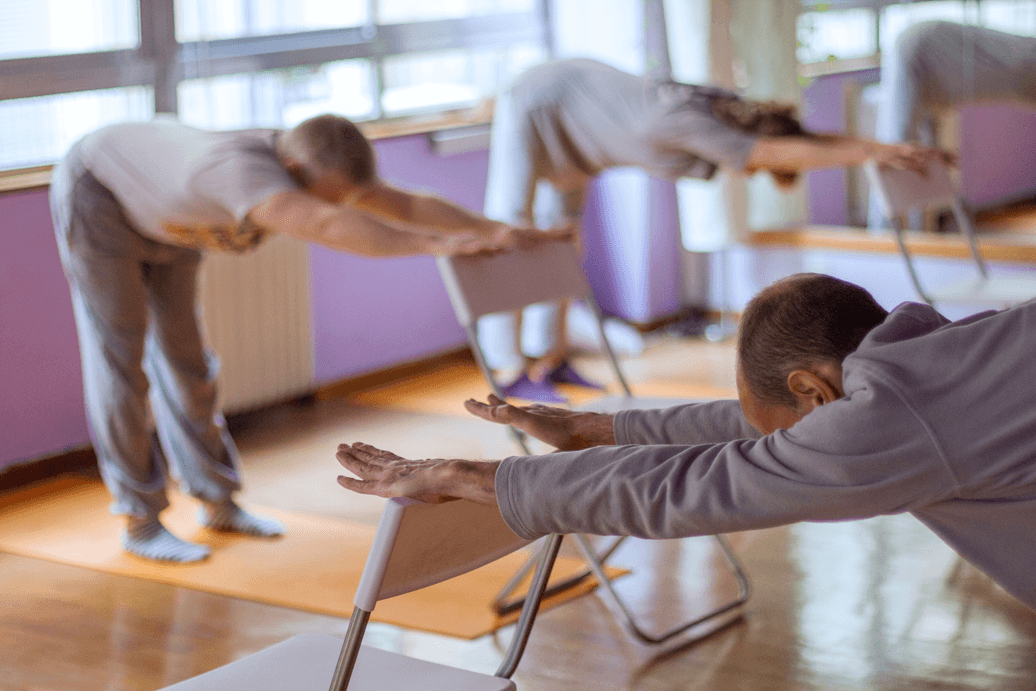
The Yoga4Health recorded classes have been risk assessed to be low risk. However, with a digital route and without a teacher watching your practice at all times, it is up to you to ensure that you listen to your body and practice the modifications offered during the session to make the course safe and within your capabilities. All classes start in a chair. If you are not physically able to go down to the mat, you can continue the session from a chair, wheelchair, or with the support of a chair. You can mix chair and mat practice as you wish. All physical practice is gentle and led by the breath. If you have any doubts about the suitability of the programme, please consult your healthcare professional. Patients join the programme at their own risk.
You will be more comfortable if you avoid eating a large meal close to the start of your class. Any loose and comfortable clothing can be worn. You will usually take off your shoes for the class, unless you need them on for medical reasons. Please ensure your practice space is clear and safe.
WHAT HAPPENS IN A YOGA4HEALTH CLASS
All Yoga4Health classes begin in a chair (or wheelchair) and those who are able work on the floor go down onto a yoga mat after the first three segments of each session as listed below. It is important to understand that this is not a gym-style yoga class. If you are looking for a physical workout you will be disappointed. Yoga postures were created hundreds of years after the essential elements of yoga were established. This course focuses on classical yoga enshrined in the 8 limbs, including the subtle and more powerful practices of breathwork, mindfulness, and concentration – alongside a highly intelligent protocol of physical practices that can be adapted to meet everyone’s needs. Stretching and mobilisation are good – and you will lengthen your muscles, increase core strength, and explore pain-free range of movement in your joints – but we want so much more for you than that. We want you to develop expert control over your breath and have at your fingertips a personal toolkit of yoga practices that work for you. Yoga practice is a daily process, not a linear goal. You will develop the skills and knowledge to clear the mind, reduce stress and anxiety, improve relaxation skills and feelings of wellbeing, and find more ease and space in your physical body. And you will be working in a way that is true to the yoga tradition dating back over two thousand years. Everything we do in class is evidence-based, secular and inclusive and we follow the same structure each week: –
- A short introduction, establishing the theme for that week’s class
- Guided breathing practice
- Opening chair sequence of breath-led movements
- Chair or mat-based practices
- Relaxation
- Guided breathing to support home practice
HOME PRACTICE/GETTING THE MOST OUT OF Yoga4Health
The aim of the Yoga4Health programme is to give you the skills, knowledge and confidence to use yoga practice to support your health and wellbeing. For this reason, we strongly encourage you to have a daily home practice of the yoga techniques you learn. Many participants find the breathing practices to be the most useful part of the course. Home practice can be for as little as 5-15 minutes per day and can fit in with your schedule. We know that people who practice regularly gain the most benefit from the Yoga4Health programme.
We also invite you to reflect on what you would like to achieve from participating in the course. This could be anything from better physical health, more mobility, or being able to better manage stress or anxiety. It is even better if you can identify a specific goal that will really help to motivate you to attend and practice at home. One NHS patient who came to us wanted to feel strong enough to make a long journey overseas to visit her daughter. Another wanted to improve his balance and mobility and feel able to move through life more confidently. Both achieved their goals.
Click here to download the Yoga4Health Digital Patient Manual 2026. Before you begin you might like to watch this short video introducing the programme….(if you require subtitles click this link to view on Vimeo and select CC)

Week 1 – Body and Breath Awareness
Catchphrase: Notice where you feel your breath
In Week 1 of the Yoga4Health programme we begin to connect to our bodies and breath, learning foundational skills for a yoga practice that supports our health and wellbeing. Breathwork and mindfulness are at the core of this programme. Research shows that they powerfully and positively effect body systems, improving your breathing, reducing stress and anxiety, and bringing space into the body. Every body is unique, so use the modified practices offered to find exactly the right level for you. Never try to work through pain or significant discomfort. Instead aim for pain-free range of motion and breath-led practice. If something doesn’t feel right, release gently from that practice. No one knows your body as well as you, so listen to it.
Week 1 class below (if you require subtitles please click on this link to be taken to the class on Vimeo where you can click on CC for subtitles)
Week 2 – Grounding Part 1
Catchphrase: Feel the touch of the body on the ground
In Week 2 we begin the first of 3 classes with a theme of “grounding”. It is important for us all to feel grounded so that we can we can function in all parts of our lives – home and work life – with stability and a sense of inner calm. In terms of our physical body, it is a great help to become more aware of the touch of the body on the ground and to use that feeling as a foundation for our posture and the different physical yoga practices that we do.
Week 2 class below. If you require subtitles please click on this link to be taken to the video on Vimeo where you can activate CC.
Week 3 – Grounding Part 2
Catchphrase: Inhale up from the ground; Exhale long ocean breath back down to the ground
Our research shows that the breathing practices are the most useful ongoing tools for patients during and after the Yoga4Health course. Our carefully constructed sequence of physical yoga practices is the same each week to build familiarity and confidence in home practice. But the breathing practices move on each week. By the end of this course you will be a breathing expert! In this class we continue to develop the theme of grounding by adding in the visualisation of our breath coming up and going back down to the ground. This imagining is like a trick to the mind, helping us to effortlessly lengthen the breath, especially in this class the long exhale.
Do the Week 3 class below. If you require subtitles please click this link to access the video on Vimeo where you can activate CC
Week 4 – Grounding Part 3
Catchphrase: Inhale ocean breath up from the ground; Exhale long ocean breath back down to the ground
In this class we move onto the next stage in our breathing journey by learning to do the technique of ocean breathing on the inhale as well as the long exhale. It is well worth investing a little bit of time in perfecting each of these ocean breathing techniques by watching the additional short breathing practice and technique videos. As your breathwork develops, the ocean breathing brings a new quality of mindfulness to your yoga practice and the realisation that you are working on your mind just as much (if not more) than the body.
Week 4 class below. If you require subtitles please click on this link to be taken to the video on Vimeo where you can active CC
Week 5 – Space
Catchphrase: Inhale-Exhale-Pause-Space
In this class we move on from grounding, but maintain our sense of mind and body stability from the classes so far. It is very difficult to experience space in the body and mind unless we also have a sense of grounding providing a feeling of foundation from which to explore the idea of creating more space. We all benefit from space, whether that is in uncluttered homes, being outdoors or in nature, or finding calm and space between our thought in the mind – even in the busiest places.
Week 5 class below. If you require subtitles please click this link to the video on Vimeo where you can activate CC
Week 6 – Space in the Shoulders
Catchphrase: Notice sensations in the shoulders in every pose
This class continues our theme of finding “space” but this time with a relentless focus on the shoulders. This part of our body is meant to be highly mobile. When tension develops in the muscles around the head, neck and shoulders, the shoulders can become tight, hunched, and rolled forwards. This can negatively affect our posture and cause discomfort. When we become more aware of sensations in the shoulders we can do something about it when tension arises, rolling them back and down. Chronic tightness in the shoulders has also been shown to negatively affect brain chemistry, so remembering to re-release the shoulders can help the physical body and our mood.
Week 6 class below. If you require subtitles, please click this link to the video on Vimeo where you can activate CC
Week 7 – Awareness of Bodily Sensations
Catchphrase: Notice the sensations in the body
In this class we focus on sensations in the whole of the body, not just the shoulders. We’ve been doing this every single week of the course. But in Week 7 we go deeper. You have now developed considerable skill and knowledge about your body and refined your awareness of breath and sensation. As we develop our attention to what we feel in our body it leads to greater day-by-day awareness of how we feel and this encourages us to listen to our bodies and look after ourselves better. Self-care using yoga tools is what this course is all about. When 279 NHS patients from West London were studied at Week 1, Week 10, and three months after they completed the Yoga4Health programme it was found that they had lost an average of 14cm from their waist measurement. We don’t specifically talk about food or diet on this course. NHS patients told the University of Westminster researchers that they naturally wanted to eat healthier food and look after themselve better through their yoga practice and this is likely why they lost so much weight.
Week 7 class below. If you require subtitles please click this link to the video on Vimeo where you can activate CC
Week 8 – Balance
Catchphrase: Find your equal breath
In this class we say goodbye to the long exhale and pause and swtich to a new breathing practice for the last 3 weeks of the course. That doesn’t mean we want you to abandon the yoga breathing techniques you have learned so far. The different versions of the breath leading up to the long exhale and pause are now very familiar to you and part of your personalised “yoga toolkit”. You can use them whenever you wish. The breathing practices so far have been designed to help you regulate your nervous system and trigger the relaxation response; ideal for relieving stress and anxiety and supporting relaxation. But in order to function well in our lives we don’t just need relaxation, we also need resilience. The equal breathing (sometimes known as coherent breathing) builds inner resilience and provides for a more energising yoga practice. The breathwork in this session is equal – balanced – and we will also continue to explore yoga postures that improve our balance. This improves our posture and the way we move, and may help us feel less at risk of overbalancing or falling.
Week 8 class below. If you require subtitles please click on this link for the video on Vimeo where you can select CC
Week 9 – Change
Catchphrase: Notice the beginning and end of the Inhale/Exale. Notice the arising and passing of sensations
In this class we continue with equal breathing and explore the theme of change. You may have changed during the 9 weeks of this course. Perhaps those changes are very apparent to you. Maybe you feel more space in your body, or are experiencing a more settled mind. Change is part of life. We may fear change and wish for everything to remain the same, but that is an illusion. In reality, if we reflect for a moment, we know that everything is in a state of flux. How we feel day by day (even hour by hour) can change from feeling healthy and well, to having a bad day or discomfort. The essence of yoga is to see life as an experience of flow, with our daily practice being a tool to keep us connected to flow and to manage the ever-changing world around us (and relationships) with greater skill and enjoyment. We can struggle against the flow, or go with the flow, using our mindfulness and breath to move through life with greater ease.
Week 9 class below. If you require subtitles please follow this link to the video on Vimeo and click CC
Week 10 – Connection
Catchphrase: We breathe together; we are all connected by breath
In this class – the last of the 10-week programme – we explore the connections that we have made in our body, mind, and breath. Many people move through life only paying attention to the body when it breaks down – like calling the garage when a car won’t start. When we have our own yoga practice that we can rely on we have a different relationship with our body. We notice the connections, the sensations, our posture, and how we are moving through the world. We notice how the breath and the mind affects the body and how the mind-body-breath connection is so strong that it’s hard to change one without changing the others. A sense of connection within ourselves also spills out into feelings of being interconnected with other people (family, friends, colleagues, people in our communities). We feel connected to ourselves and this helps us feel socially connected to others and brings a new quality to those connections. You may also find yourself yearning for greater connection, and finding it in simple (and inexpensive) passtimes like taking a walk in nature.
Week 10 class below. If you require subtitles please use this link to open the video on Vimeo and click on CC
What’s next after the Yoga4Health programme?
Well done. You have completed the Yoga4Health programme. Please watch out for the end-of-course evaluation that will be sent to you if you registered for this course. Your feedback is so important to help us improve the course and show the NHS the positive impact it is having. If you have completed all 10 sessions you can download your course completion certificate Yoga4Health Course Completion Certificate. This short video gives advice on continuing your yoga journey and accessing YIHA home practice resources. If you require subtitles, please use this link to access the video on Vimeo and click CC